
Tender preparation, handled.
TENDRA prepares the documents behind a tender response — from the first read of the requirements to a structured package ready for your approval. You keep control of the facts, pricing and final submission.
 Illustrative example
- Response document
- Requirements register
- Schedules and forms
- Open items list
A prepared service
You receive prepared documents — not software to learn or operate.
AI-assisted, human-reviewed
AI assists with analysis and drafting; a person reviews the work before handover.
Scoped per tender
Deliverables depend on each tender and are confirmed before work begins.
Everything between the tender pack and your sign-off.
- 01
Tender documentation and requirements analysis
We read the full tender pack — conditions, specifications, evaluation criteria and returnables — and set out what the buyer is asking for.
- 02
Submission obligations and response criteria
Mandatory requirements, format rules, page limits, declarations and closing arrangements are identified and listed.
- 03
Mapping your information to requirements
The company information and evidence you supply is matched to each requirement, so every answer points to something real.
- 04
Drafting professional responses
Clear, structured responses to each criterion, written from verified information about your business, in the buyer’s required format.
- 05
Schedules and supporting material
Relevant schedules, returnable forms and structured supporting material prepared from the information you provide.
- 06
Missing evidence and outstanding requirements
Gaps are flagged early and kept in a single open-items list, so nothing is quietly assumed.
- 07
Human review and quality checks
Every prepared response is reviewed by a person for completeness, consistency and unresolved items before handover.
- 08
A prepared package for your approval
You receive the package ready for your final review, changes and approval. You submit it to the buyer.
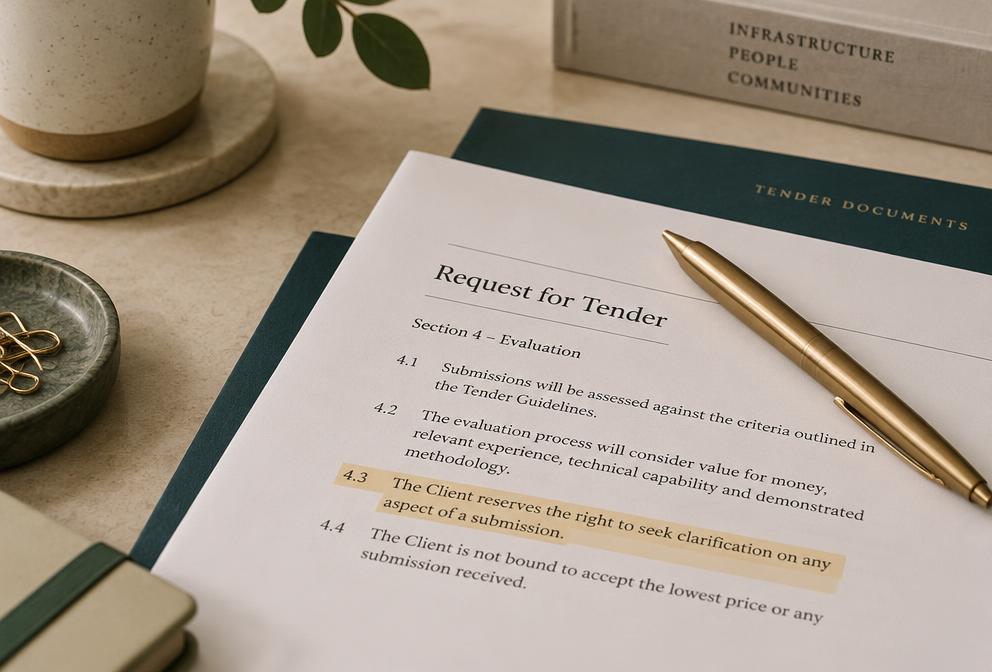
Every requirement, matched to real evidence.
We read the conditions, criteria and returnables, list what the buyer is asking for, then map each requirement to information you supply. Where evidence is missing, it’s flagged — not assumed.
- 1Read the tender pack
- 2List every requirement and obligation
- 3Match supplied evidence
- 4Flag gaps for your decision
Four parts, one coherent response.
Structured answers to each evaluation criterion, written from supplied information and in the buyer’s format.
| C1 | Relevant experience | Ready for review |
| C2 | WHS approach | Ready for review |
| C3 | Key personnel | Information required |
| R4 | Insurance certificates | Ready for review |
- Schedule A — Company detailsPrepared
- Schedule B — RefereesPrepared
- Schedule C — Pricing (you complete)For you
- Returnable — Declaration (you sign)For you
- Key personnel CVs not yet suppliedNeeded for C3
- Confirm current public liability expiryNeeded for R4
- Pricing approachYour decision
You provide the facts. We prepare the response.
Responses are built only from information you supply and approve. Decisions that commit your business stay with you.
You provide
- The tender opportunity and closing date
- Company details, capability and relevant experience
- Policies, insurances, licences and accreditations you hold
- Pricing, resourcing and commercial decisions
- Answers to clarification questions
- Final approval of facts, commitments and declarations
- Submission to the buyer
Tendra prepares
- Requirements analysis and response plan
- Requirements register mapped to your evidence
- Drafted responses to each criterion
- Prepared schedules and returnable forms
- Open-items list of missing evidence and decisions
- Human review before handover
- A prepared package, ready for your review
You submit
Tendra does not submit tenders on your behalf. You approve and lodge the final response.
No guarantees
We don’t guarantee award, eligibility, accuracy or compliance. The procurement decision rests with the buyer.
Scope confirmed first
Every engagement starts with an assessment, then a proposal confirming scope, deliverables and fees.
See how it works for each stage of an engagement.
Have a tender assessed.
Tell us about the opportunity and its closing date. We’ll review the requirements and suitability, then confirm the next steps.
Please keep confidential tender documents out of the initial form.